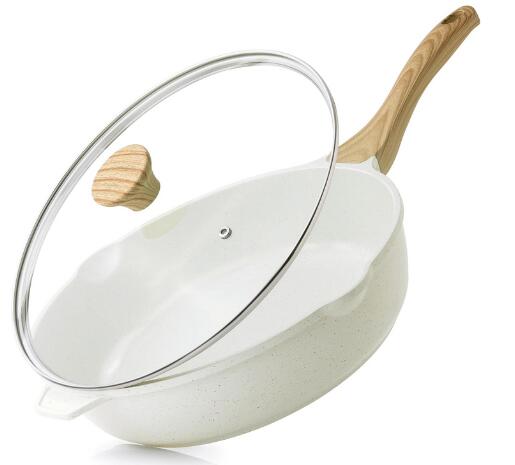
Is Ceramic Non Stick Cookware Safe ?
Ceramic nonstick pans are an increasingly common and popular alternative to PTFE nonstick pans. Is Ceramic Non Stick Cookware Safe ?
Is Ceramic Non Stick Cookware Safe to use?
Yes, Ceramic nonstick pans are safe as long as they are not overheated or damaged. Ceramic pans are not manufactured with PTFE or PFOA, and this is why you’ll often see them labeled as “nontoxic.”
A ceramic-coated pan is essentially any metal pan with a thin ceramic layer on top. As for the ceramic coating, most are not truly ceramic. They’re actually “sol-gel” coatings containing silica (sand) and other inorganic chemicals. Sol-gel is the preferred method of applying ceramic coatings to cookware to make it nonstick.
While Sol-gel coatings are technically harder and able to withstand higher temperatures than PTFE coatings, most companies advise their customers against heating ceramic-coated pans above 500 degrees — any hotter, and the ceramic coating could decompose.
When Sol-gel decomposes, ceramic-coated pans can lose their nonstick properties, and the surface can become coarse or gritty. As a result, these pans are not usually recommended for use in the dishwasher or under the broiler.
Best Rated & Bestselling Ceramic Nonstick Products on Amazon
No products found.
No products found.
No products found.
No products found.
If you’re still concerned, I’d highly recommend cast iron or stainless steel cookware. Unlike non-stick pans that typically last about 1 years, these durable materials can truly last a lifetime with proper care. Plus, they can deliver excellent non-stick performance when used correctly – I’ll share pro tips below to help you master the technique.
Want absolute peace of mind? The Trustworthy Alternative
1, Cast iron and carbon steel: high-heat wonders
Cast-iron pans have existed for hundreds of years, and scores of decades-old pans are still being used regularly. Carbon-steel pans are a more-recent cookware development, and they have grown more popular in the US in the past several years.
Top Pick
The best cast-iron skillet: Lodge Chef Collection 12-Inch Cast Iron Skillet
This affordable pan is lighter than a traditional cast-iron skillet and a little shallower. It’s an ideal shape for searing, roasting, and sautéing.
No products found.
Merten & Storck Pre-Seasoned Carbon Steel 12″ Frying Pan Skillet
This kitchen workhorse can fry an egg without sticking, and it produces a dark, crusty sear on steaks and chops.
No products found.
Cast-iron and carbon-steel pans stay nonstick through a process called “seasoning,” in which layers of polymerized fat are baked onto the metal to create a slick cooking surface.
While a carbon-steel or cast-iron pan will never be as nonstick as a PTFE pan, you can get close. The key to using these pans effectively is knowing how to build and maintain that seasoning, as well as utilizing some best practices for cooking in them. (I outline some tips on that a little farther down.)
Both our top-pick carbon-steel pan and our favorite cast-iron pan come pre-seasoned, so new pans already have a relatively nonstick base from first use. But you need to continue to build that base over time—likely for around three to six months.
2, Stainless steel: nonstick, if you believe in yourself
Top pick – All-Clad D3 Stainless 12″ Fry Pan with Lid
This skillet is a proven workhorse with superior heat conduction and durable construction.
No products found.
If you just love giving your pan a good scrub and can’t break the habit, this might blow your mind: You can absolutely cook food in stainless steel without it sticking.
Many professional chefs use stainless-steel skillets for all kinds of tasks. They can’t do everything—custardy, soft-scrambled eggs are a challenge, though not impossible—and with the right technique, stainless skillets can get you pretty far. The good news is that cooking in stainless is identical to the steps you’d take with a cast-iron or carbon-steel pan, though you don’t need to be nearly as precious when you’re cleaning.
How to cook to maximize the slide in carbon-steel, cast-iron, and stainless-steel pans
- Preheat the pan. You want to make sure it’s nice and hot. One trick is to look for the Leidenfrost effect—a few droplets of water added to the pan will dance across the surface.
- Once the pan is hot, add a good amount of fat—oil, butter, lard, whatever brings you the most joy. Don’t skimp. Use one tablespoon at a minimum. (If you want to use less oil, may we suggest baking or air frying instead?)
- Don’t touch the food until it’s had a chance to cook and release. Many foods will initially adhere to the pan, but once they’ve cooked a bit, they’ll let go.
- Use the pan frequently. With carbon-steel and cast-iron pans, the more use they get, the more nonstick they will become. I keep my carbon-steel pan on the stovetop because I love to look at it, and also because it’s easier to grab when I need it.
I have faith that you’re going to get that carbon-steel beauty up and running to its maximum potential. And then, whenever you need to make a rich tomato sauce or a red-wine reduction, go ahead and pull out the stainless steel.